


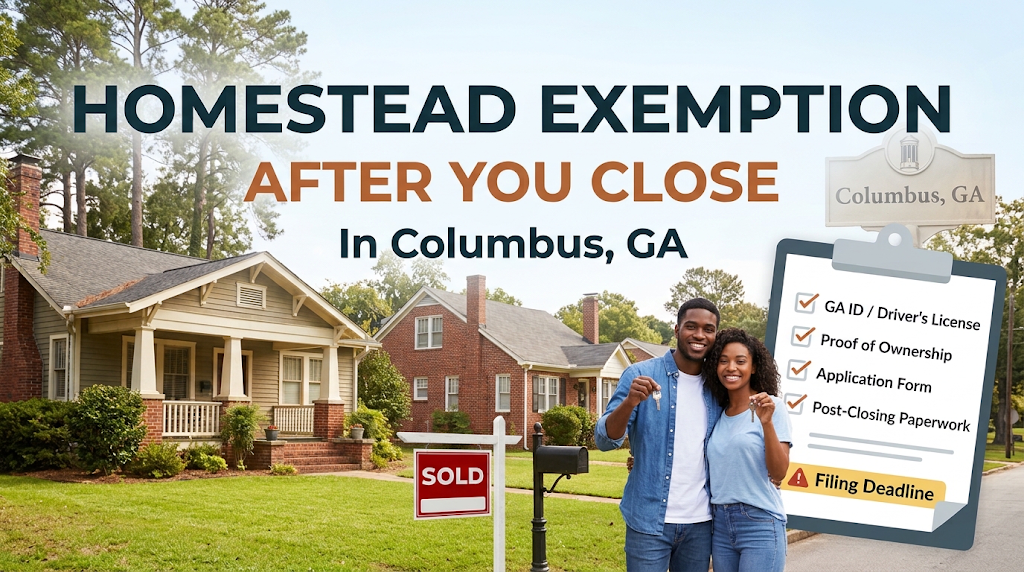
When can I file for a homestead exemption after buying a home in Columbus, GA or Phenix City, AL?
In Georgia, you can claim a homestead exemption for a tax year only if you owned and lived in the home on January 1 of that year, and you have to apply by April 1. Close on December 31 and you can file for 2027 right away. Close on January 2 and you wait until 2028. In Muscogee County, the standard homestead also freezes your assessed value, so filing on time matters for years. In Phenix City and the rest of Alabama, you take your recorded deed to the county Revenue Commissioner's Office and claim homestead there.
By Matt Horne, REALTOR® | November 23, 2026
The homestead exemption is the easiest tax break you'll ever get as a homeowner. It's also the one new owners miss most often.
Nobody files it for you. Not your lender, not your closing attorney, not the county. You own the house, the deed gets recorded, and unless you apply, you pay full freight on next year's tax bill.
The timing matters more than most buyers realize, especially this time of year. If you're closing in November, December, or January anywhere in the Chattahoochee Valley, a few days on either side of January 1 can change what you pay for an entire year.
Here's how it works on both sides of the river, and what to do after you get your keys.
The Georgia rule: own it on January 1, file by April 1
Georgia's rules are simple on paper:
- You must own the home and live in it as of January 1 of the year you're claiming.
- It has to be your legal residence for all purposes, and you can't claim a homestead exemption on any other property, in Georgia or any other state.
- You must apply by April 1. File after April 1 and the exemption starts the following year. The state treats a missed deadline as a waiver.
- It renews automatically after that, as long as you own and live in the home.
That January 1 date is where closing schedules come in.
Why a December closing can beat a January closing
Say you're under contract on a home in North Columbus, and the closing could land on December 30 or January 6.
- Close December 30: You own the home on January 1, 2027. You can file for your 2027 homestead as soon as your deed is recorded, and you have until April 1, 2027.
- Close January 6: You didn't own the home on January 1, 2027. You can't claim homestead until the 2028 tax year.
That's a full tax year without your exemption. And in Columbus, it's more than a single year's savings, because of the freeze.
Columbus and Muscogee County: the freeze makes it a bigger deal
In Columbus, the standard homestead exemption takes a $13,500 reduction off your assessed value. It also freezes the assessment on your home for the maintenance and operations portion of your tax bill. The freeze doesn't apply to bond debt.
The Muscogee County School District has described this as a county-wide freeze on the assessed value of homestead property. When Georgia passed its newer statewide "floating" homestead law, the school district announced plans to opt out and keep the local Frozen Assessment Homestead in place.
What that means for you as a buyer:
- The freeze protects you from rising assessments for as long as you own and live in the home.
- The seller's freeze doesn't transfer to you. Their exemption ends when the home changes hands, and you start your own.
- The sooner you file, the sooner your own protection starts.
Before you close, ask the Muscogee County Board of Assessors how your assessed value will be set after the sale. That way you aren't caught off guard by your first bill.
Harris County: new construction buyers, read this twice
Most new construction in Harris County (Hamilton, Cataula, Mulberry Crossing) is owned by the builder on January 1, and builders don't carry a homestead exemption. If you close on a new build in early January, your first full year's bill will likely reflect no homestead at all.
When you do file, Harris County's Board of Tax Assessors adopted a residency checklist in July 2026. Plan on bringing:
- A Georgia driver's license or Georgia ID
- Plus one of: vehicle registration, voter registration, or other proof the Chief Appraiser asks for
- If your mailing address differs from the property address: a sworn affidavit and three bills dated within the last 60 days showing your name and the property address (power, water, gas, landline, or mortgage statement; cell phone and cable bills don't count)
If you're weighing a build in Harris County against a resale in Columbus, I cover the bigger picture in what buyers need to know about new construction in Columbus and the surrounding area.
The 2026 state grant only went to homesteads
There's one more reason to file on time. For 2026, Georgia funded a Homestead Tax Relief Grant worth an $18,000 reduction in assessed value on qualifying homes. It applied only to homes with a homestead exemption filed by the April 1 deadline. Rentals didn't qualify.
At a hypothetical 40 mills, an $18,000 cut in assessed value works out to about $720 off the bill. Your actual savings depend on your millage rate. The state hasn't promised the grant every year. If it comes back, though, only homeowners with a homestead on file will get it.
Who pays this year's taxes when you close mid-year?
In Columbus, the January 1 owner is legally responsible for the whole year's property tax, even if the home sells in July. The tax commissioner doesn't split the bill. The buyer and seller split it at closing, and the closing attorney prorates it on the settlement statement.
So if you buy in 2026, your 2026 bill will often still show the seller's name, and possibly the seller's homestead. You covered your share through the proration at closing. Your first bill under your own homestead comes the following year.
If you're mapping out the full process, start with my closing timeline guide for Columbus.
Phenix City and Alabama: take your deed to the Revenue Commissioner
Alabama works differently, which is one of the reasons the side of the river you buy on matters. For a full side-by-side, see my cross-state buyer's guide to Georgia vs. Alabama.
In Phenix City, Russell County, and Lee County:
- Record your deed in the county Probate Office. Your closing attorney or title company usually handles this.
- Assess the property in your name at the county Revenue Commissioner's Office. Bring your deed.
- Claim your homestead there. Alabama's exemption is for a single-family home you own and live in as your primary residence on the first day of the tax year.
Alabama property taxes are due October 1 and delinquent after December 31. The tax bill often stays in the previous owner's name for a while after you buy. The state is clear that you're still responsible for taxes on property you own, however the bill is addressed. Don't wait for a bill to show up before you visit the Revenue Commissioner.
Homeowners who are over 65, permanently and totally disabled, or blind are exempt from the state portion of the property tax in Alabama. County taxes may still apply.
Fort Benning buyers: check your legal residence first
This is the question I get most from military families, and it's worth slowing down on.
A Georgia homestead exemption requires the home to be your legal residence for all purposes, and Harris County asks for a Georgia driver's license or ID. Many service members keep their legal residence in another state for tax purposes. Claiming a Georgia homestead may not fit with that, and it could affect your state income tax picture back home.
Before you file, talk to the legal assistance office on post or a tax professional. Decide which state is home on paper, then file (or don't) on purpose.
A few more things military buyers should know:
- 100% disabled veterans can qualify for a much larger exemption. In Columbus, it's up to $121,812 off assessed value (the 2025 figure). You'll need your VA benefits letter.
- Unremarried surviving spouses of service members killed in a war or armed conflict may also qualify, with documentation from the Department of Defense.
- If you're renting your home out after a PCS, homestead won't apply because it isn't your residence. I cover that trade-off in PCS orders from Fort Benning: sell or rent your home.
Your after-closing checklist
Whichever side of the river you buy on, here's the order I give my clients:
- Pick your closing date with January 1 in mind. If you're close to year-end, ask whether closing before December 31 is realistic.
- Get a copy of your recorded deed. Your closing attorney can send it.
- Update your driver's license and vehicle registration to the new address if this is your legal residence.
- File with the right office:
- Columbus: the Property Tax Division of the Tax Commissioner's Office, 3111 Citizens Way
- Harris County: the Board of Tax Assessors in Hamilton
- Phenix City, Russell County, or Lee County: the county Revenue Commissioner's Office
- Ask about every exemption you qualify for, including age-based, disability, and veteran exemptions.
- Put April 1 on your calendar if you're in Georgia, and don't wait until March.
Frequently Asked Questions
Can I file for homestead exemption the same year I buy my house in Georgia?
Only if you owned and lived in the home on January 1 of that year. If you close any time after January 1, your first eligible year is the next one, and you must apply by April 1 of that year.
What's the deadline for homestead exemption in Columbus, GA?
April 1. Columbus accepts applications year-round, but anything filed after April 1 applies to the following tax year. You'll need your recorded warranty deed, proof of occupancy, and proof of Georgia residency.
Does the seller's homestead exemption transfer to me?
No. The seller's exemption, and in Columbus the seller's frozen assessment, ends when ownership changes. You file your own, and your own protection starts once it's approved.
Is it better to close in December or January for property taxes in Georgia?
For homestead purposes, closing on or before December 31 lets you claim the exemption for the coming year. Closing in early January pushes your first homestead year out by twelve months. Your loan, your lease, and your move all factor in too, so weigh the whole picture.
How do I get homestead exemption in Phenix City, AL?
Take your recorded deed to the Russell County Revenue Commissioner's Office (or Lee County, if your home is there), have the property assessed in your name, and claim homestead. Don't wait for a tax bill, since it may still be in the prior owner's name.
The bottom line
The homestead exemption costs nothing but a trip to the county office. The rules aren't hard. What trips people up is the timing: a closing date a few days past January 1, a missed April 1 deadline, or a Fort Benning buyer who files without thinking through their legal residence.
If you're buying in the Chattahoochee Valley and your closing could land on either side of New Year's, plan the date around it. Every move here has its own costs, deadlines, and fine print, especially when you're deciding which side of the river to buy on. Book a free 15-minute strategy call and I'll walk you through your timeline, your tax picture, and exactly what to file after closing, with numbers, not guesswork.
About Matt Horne, REALTOR®
Matt Horne is a REALTOR® with Coldwell Banker Kennon & Parker, licensed in Georgia and Alabama since 2017 and a member of Coldwell Banker's International President's Circle every year since 2019. He helps buyers and sellers across Columbus, Phenix City, Harris County and Lake Harding make confident real estate decisions, with a focus on new construction, corporate relocation and PCS military moves. Before becoming an agent, he ran his own business and bought, renovated and sold a blighted commercial building in Midtown himself.
Matt Horne, REALTOR® | Coldwell Banker Kennon & Parker. This article is general information, not legal or tax advice. Tax rules and exemption amounts change. Confirm current figures and deadlines with the Columbus Tax Commissioner, the Harris County Board of Tax Assessors, or your county Revenue Commissioner in Alabama, and talk to a tax professional about your situation.
Check out this article next